
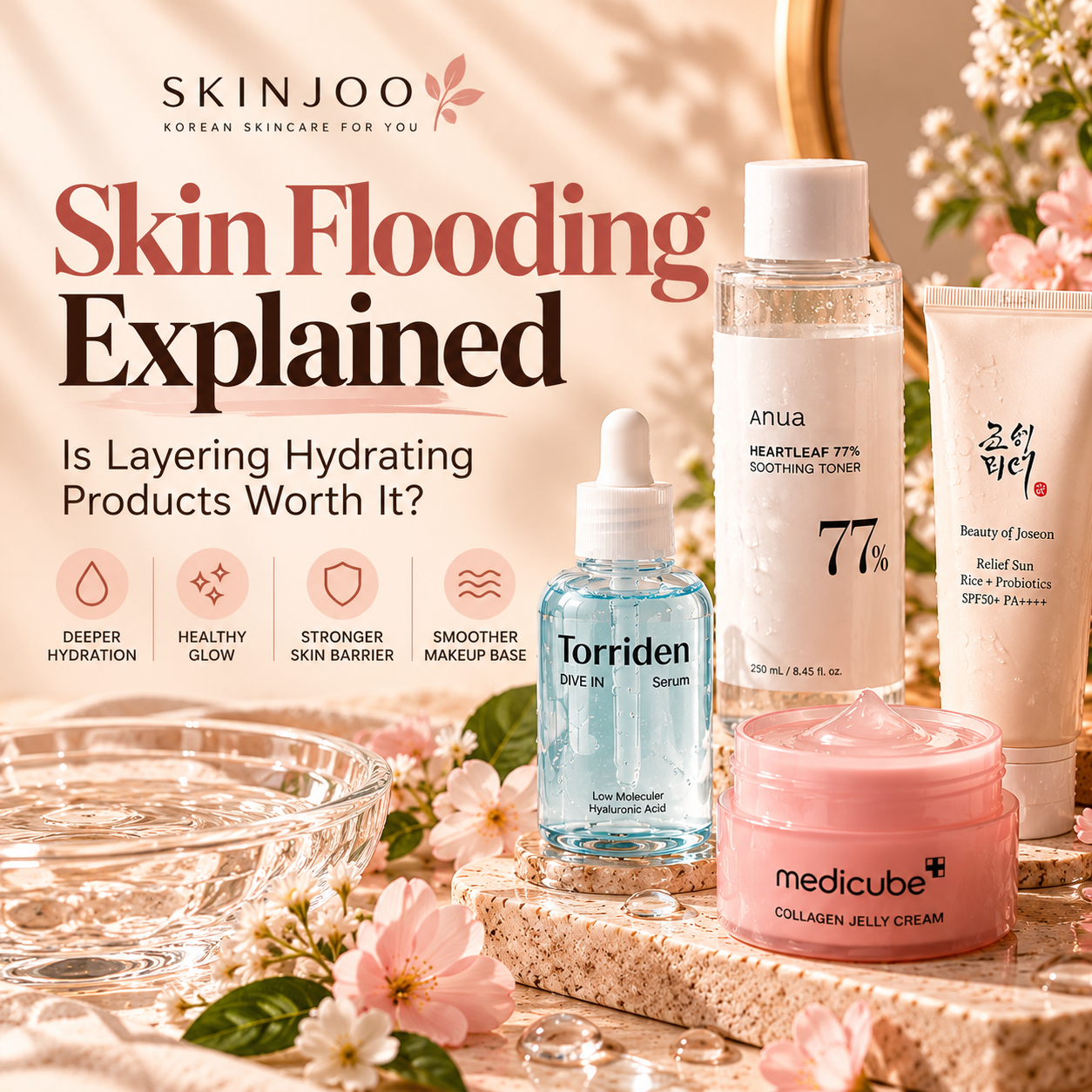
Have you ever finished your skincare routine only to find that your skin still feels tight, looks dull, or lacks that fresh, hydrated appearance?
You might have come across a skincare trend called skin flooding. Popular in beauty routines, this technique focuses on layering hydrating skincare products to help the skin retain moisture and feel more comfortable.
The idea sounds simple: add hydration in layers, then seal it in with moisturiser.
But does skin flooding actually make a difference? Do you need multiple serums and toners to try it? And is it suitable for every skin type?
At SkinJoo, we believe skincare should be practical, personal, and easy to understand. Let’s explore how skin flooding works, which ingredients to look for, and how to decide whether this technique deserves a place in your routine.
1. What Is Skin Flooding?
Skin flooding is a skincare technique that involves applying hydrating products in layers, often starting with a lightweight toner or essence and following with a hydrating serum and moisturiser.
The goal is to increase moisture in the outer layers of the skin and help reduce moisture loss.
Hydrating products commonly contain humectants—ingredients that attract and retain water. Examples include glycerin, hyaluronic acid, and panthenol.
A moisturiser then helps maintain skin comfort by combining ingredients that attract water, soften the skin, and reduce moisture loss.
Skin flooding isn’t a medical treatment or a requirement for healthy skin. It’s simply one way to organise a hydrating skincare routine.
The SkinJoo takeaway: You don’t need five products to flood your skin. One hydrating product followed by a suitable moisturiser may be enough.
2. How Does Skin Flooding Work?
Your skin’s outermost layer helps protect it from environmental stressors and reduce water loss. When this layer isn’t retaining moisture effectively, your skin may feel dry, tight, or rough.
Skin flooding aims to support hydration through two complementary steps.
Step one: Add hydration
Products containing humectants such as glycerin, hyaluronic acid, or panthenol can help attract and retain water in the outer layers of your skin.
These ingredients are commonly found in toners, essences, and serums.
Step two: Help maintain moisture
After applying your hydrating product, use a moisturiser suited to your skin.
Depending on its formulation, a moisturiser may contain humectants, emollients, and occlusive ingredients that soften the skin and help reduce moisture loss.
This combination can help your skin feel more comfortable and appear temporarily plumper.
However, results depend on the product formulation, your skin’s condition, and how consistently you use a suitable routine. More layers do not automatically mean more hydration.
3. Who Should Try Skin Flooding?
Skin flooding may be worth trying if your skin frequently feels dry, tight, or dehydrated.
Here is how you can adapt the technique to different skin needs.
Dry skin
Dry skin often benefits from a combination of hydration and moisturisation.
You might prefer a hydrating serum followed by a richer cream containing ingredients such as ceramides, glycerin, or emollients.
The aim is to help your skin feel softer and more comfortable without repeatedly applying unnecessary layers.
Oily skin
Oily skin can also become dehydrated. Excess oil doesn’t automatically mean that your skin contains enough water.
If your skin feels tight after cleansing but becomes shiny during the day, consider a lightweight hydrating serum and a non-greasy moisturiser.
Avoid layering several thick creams simply because the technique is trending.
Combination skin
Combination skin may benefit from a flexible approach.
A lightweight hydrating serum can be used across the face, followed by a moisturiser that suits your skin. If certain areas feel drier, you may choose to apply a little more moisturiser there, provided the product is suitable.
Sensitive skin
If your skin is sensitive, keep the routine simple and choose products with ingredients you already tolerate.
Introduce new products one at a time. Fragrance-free formulas may be preferable for some people, although individual reactions vary.
If your skin is currently red, stinging, or irritated, focus on gentle cleansing and moisturisation rather than experimenting with multiple new products.
Remember: Skin flooding isn’t suitable for everyone in the same way. Your skin’s comfort matters more than the number of layers you apply.
4. Ingredients to Look for in Skin-Flooding Products
You don’t need to buy products specifically marketed as skin-flooding products. Instead, look for useful hydrating ingredients in formulas that suit your skin.
Hyaluronic acid
Hyaluronic acid is a humectant that helps attract and retain moisture in the outer layers of the skin.
It is commonly found in hydrating serums and lightweight moisturisers.
Glycerin
Glycerin helps attract water and supports hydration. It is widely used in skincare products for different skin types.
Panthenol
Panthenol, also known as provitamin B5, is often included in moisturising and soothing skincare formulations.
It can help support skin hydration and comfort.
Ceramides
Ceramides are lipids naturally present in the skin barrier. Moisturisers containing ceramides can help support the barrier and reduce moisture loss.
They are especially worth considering if your skin tends to feel dry or tight.
Squalane
Squalane is an emollient that helps soften the skin and improve the feel of a moisturiser.
Depending on the formulation, it can be useful in routines designed to support dry or dehydrated skin.
You don’t need all these ingredients in separate products. A well-formulated moisturiser may already contain several of them.
Read ingredient lists, consider your skin’s needs, and avoid choosing products based only on trending ingredients.
5. How to Try Skin Flooding: A Simple Step-by-Step Routine
If you want to try skin flooding, start with a few products rather than building an elaborate routine immediately.
Step 1: Cleanse gently
Use a cleanser suited to your skin and rinse with lukewarm water.
Avoid harsh cleansing or excessive scrubbing, which may leave your skin feeling tight.
Step 2: Apply a hydrating toner or essence (optional)
If you enjoy using a toner or essence, choose one designed to provide hydration.
Apply it according to the product directions. You don’t need to apply multiple layers if one is sufficient.
Step 3: Use a hydrating serum
Apply a suitable serum containing ingredients such as glycerin, hyaluronic acid, or panthenol.
Some people prefer applying hydrating products to slightly damp skin, but always follow the product’s instructions. If damp application causes discomfort or irritation, adjust your technique.
Step 4: Apply moisturiser
Follow with a moisturiser to help maintain hydration.
Choose a lightweight lotion if you prefer a lighter feel, or a richer cream if your skin needs more moisture.
Step 5: Finish with sunscreen in the morning
If you’re following the routine during the day, finish with broad-spectrum sunscreen with SPF 30 or higher.
Apply it as directed and reapply according to the label, especially when outdoors, sweating, or swimming.
At night, you can finish with your moisturiser instead.
A simple rule: Start with one hydrating product and a moisturiser. Add another layer only if your skin genuinely benefits from it.
6. Common Skin-Flooding Mistakes to Avoid
Although skin flooding sounds straightforward, there are a few mistakes that can make your routine less comfortable.
Using too many layers
Applying several toners, essences, and serums doesn’t guarantee better results.
Too many products may leave your skin feeling sticky or increase the chance of irritation, particularly if formulas contain active ingredients that don’t suit your skin.
Start with fewer products and add only what you need.
Choosing products that don’t suit your skin
A product that works well for one person may feel too heavy or irritating for someone else.
Consider your skin type, current concerns, and tolerance when choosing a hydrating serum or moisturiser.
Skipping moisturiser
Hydrating products alone may not provide enough support for every skin type.
A suitable moisturiser helps maintain skin comfort and may reduce moisture loss.
Using harsh products before flooding
If your skin feels dry or irritated after cleansing, adding more serums may not solve the underlying issue.
Review your cleanser and reduce potentially irritating treatments if necessary.
Expecting instant, permanent results
Hydrating products may temporarily make skin look plumper and feel softer, but they cannot permanently change your skin structure.
Results vary, and ongoing hydration generally depends on using products that suit your skin consistently.
Ignoring irritation
If a new product causes persistent burning, redness, itching, or swelling, stop using it. Don’t keep layering products in an attempt to calm a reaction.
Seek professional advice if symptoms are significant or persistent.
7. Skin Flooding vs. Slugging: What’s the Difference?
Skin flooding and slugging are often discussed together, but they are different techniques.
Skin flooding focuses on layering hydrating products, usually followed by moisturiser.
Slugging involves applying an occlusive product, often petrolatum-based, as the final step to help reduce moisture loss.
Skin flooding focuses on adding hydration, while slugging focuses more heavily on limiting water loss from the skin’s surface.
Some people may benefit from elements of both approaches, but neither is essential for everyone.
If you have acne-prone skin, are sensitive to heavy products, or use prescription treatments, consider whether an occlusive layer is appropriate for your skin. Follow your treatment instructions and seek professional guidance when needed.
You can also achieve a simple, effective routine without trying either trend.
8. Practical K-Beauty Products to Consider
Korean skincare offers a variety of hydrating toners, serums, essences, and moisturisers. The best choices depend on your skin’s needs rather than how many products you use.
Here are a few options to explore, subject to current availability at SkinJoo.
Torriden DIVE-IN Serum
A hydration-focused serum featuring hyaluronic acid.
Why consider it: It may be a useful option if you want a dedicated hydrating step before moisturiser.
Where it fits: After cleansing and before moisturiser.
Anua Heartleaf 77% Soothing Toner
A lightweight toner option for people who enjoy adding a toner to their routine.
Why consider it: It can be an optional hydration step if its formulation suits your skin.
Where it fits: After cleansing and before serum or moisturiser.
A ceramide-containing moisturiser
Look for a moisturiser formulated with ceramides and other ingredients that help support skin comfort.
Why consider it: It can help complement a hydrating serum by supporting the skin barrier and reducing moisture loss.
Where it fits: As the moisturising step after your hydrating products.
A gentle cleanser
Choose a cleanser that removes everyday impurities without leaving your skin feeling uncomfortably tight.
Why consider it: A gentle cleansing step helps create a comfortable starting point for the rest of your routine.
Where it fits: At the beginning of your morning or evening routine, as appropriate.
Product formulas and availability may change, so check the current ingredient list and product directions before purchasing.
9. Do You Need Skin Flooding Every Day?
Not necessarily.
Some people find a simple hydrating serum and moisturiser sufficient for everyday use. Others prefer additional layers during colder weather or when their skin feels dry.
Your routine can change according to your needs.
For example:
- During hot, humid weather, a lightweight serum and lotion may feel more comfortable.
- During colder or drier weather, you may prefer a richer moisturiser.
- When your skin feels irritated, you may benefit from simplifying your routine rather than adding more products.
You don’t need to follow the trend every day or use the same number of layers morning and night.
Pay attention to how your skin feels, keep the routine manageable, and make changes gradually.
10. Is Skin Flooding Worth Trying?
Skin flooding can be a useful way to organise a hydration-focused routine, especially if your skin often feels dry or tight.
However, it isn’t a miracle treatment, and you don’t need a long list of products to achieve comfortable, hydrated-looking skin.
For many people, the essentials are straightforward: cleanse gently, use a suitable hydrating product if needed, apply moisturiser, and protect your skin from the sun during the day.
If you already have a routine that keeps your skin comfortable, there may be no reason to change it.
At SkinJoo, we believe that understanding your skin is more valuable than following every beauty trend.
Ready to refresh your hydration routine? Explore your skincare essentials, choose products that fit your needs, and keep every step purposeful.
Your skin doesn’t need more products just because a trend says so. It needs the right care for you.